News Posts matching #bLLC

Return to Keyword Browsing

Intel Core Ultra 4000 "Nova Lake-S" Preliminary Specs Leaked

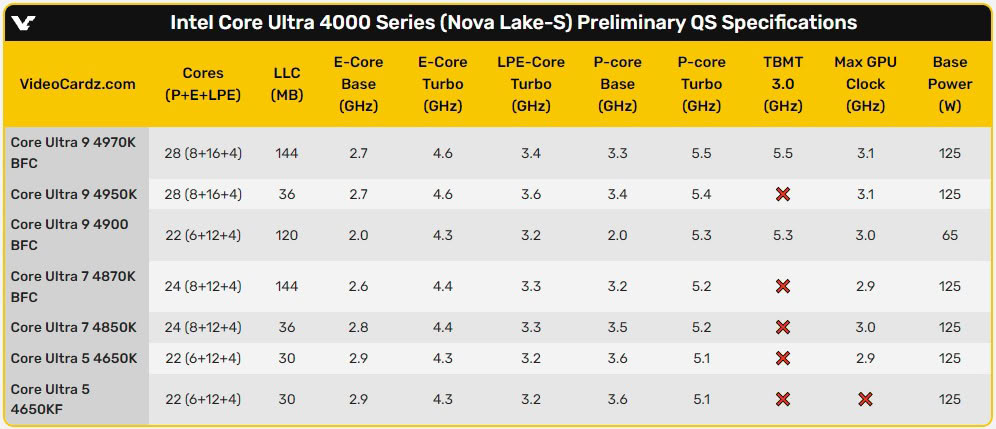
More information has surfaced about Intel's upcoming "Nova Lake-S" desktop CPU lineup. According to an Intel document obtained by Videocardz, the Core Ultra 4000 series lineup will be led by the Ultra 9 4970K BFC, with 28 cores and 144 MB of L3 cache, along with a 5.5 GHz boost clock. The document lists specs for seven Nova Lake-S desktop chips. Videocardz notes that these are C1-stepping qualification samples, so there may be some changes between these specs and the retail models, particularly the final clock speeds. We don't often see changes between qualification samples and retail processors so close to launch, but it's something to remember regardless.

Looking at the table, the Core Ultra 9 4950K slots in just under the flagship 28-core 4970K BFC. The 4950K also has 28 cores in an 8P+16E+4LPE configuration, but it drops the BFC suffix and doesn't carry the additional L3 cache, topping out at 36 MB. The boost clock drops from 5.5 GHz on the 4970K to 5.4 GHz on the 4950K. This settles the confusion around the 4950K's core count, since the October lineup leak showed it without any LPE cores. There's also the 22-core Ultra 9 4900 BFC, an interesting non-K SKU that has fewer cores than the Ultra 7 models. This model only has a 65 W TDP, while all other leaked variants show a 125 W base power rating.

Intel Razor Lake Gets a 12 P-Core bLLC Chip With No E-Cores, Per Leak

Intel's Razor Lake desktop lineup could include an unlocked gaming chip with 12 P-cores and no regular E-cores at all. Well-known Intel leaker Jaykihn shared the "12+0+4" configuration on X, which pairs those 12 P-cores with four low-power E-cores and Intel's big Last Level Cache (bLLC), the company's answer to AMD's X3D chips. In a follow-up post, he said this SKU replaces a locked 8+0+4 bLLC part that was rumored earlier. Apparently, all 12 P-cores sit on a single compute die designed only for P-cores, rather than a hybrid die with its E-cores switched off, and Jaykihn later said that tile is built on Intel's own 18A-P node. That would make it an outlier, since most Razor Lake compute tiles are reportedly headed to TSMC.

Jaykihn also claims the 125 W 6+12+4 bLLC chip, one of the two 22-core Nova Lake-S parts that leaked back in July, has been pushed from Nova Lake to Razor Lake. If that's accurate, it seems Nova Lake-S will launch with one less bLLC option than expected. There's no word on the 65 W version. Razor Lake-S is currently a 2028 product that should use the same LGA-1954 socket as Nova Lake-S, according to Jaykihn's earlier posts. Intel has listed Razor Lake model IDs in its ISA reference, but none of these specs are official. Plans this far out can change, so it's reasonable to treat the 12 P-core chip as just a target for now.

Intel Nova Lake-S Promises Up To 17% Single-Thread and 20% Gaming Performance Improvements

A lot of information relating to Intel Nova Lake-S has emerged leading up to the official launch in early 2027, including official information from Intel detailing the Nova Lake architecture and a recent benchmark leak that promised significant single-thread performance improvements on a 28-core Nova Lake-S part. However, a recent leak out of @Haze2K1 on X, shared by VideoCardz, purports that the real-world performance improvements for Intel's Nova Lake desktop CPUs are in the double digit range.

While the leaker has been around for a while, there is no guarantee that this information is accurate, since the only cited source is "circulating chatter," however, the claim is that Intel's Nova Lake will outperform comparable last-generation Arrow Lake CPUs by 8-17% in raw single-thread performance, 15% in general-purpose workloads, and up to 20% in gaming. There is some nuance to these claims, with the 17% improvement figure exclusive to the higher-end CPUs that feature bLLC, while the 17% boost allegedly comes from the implementation of Intel's new Advanced Performance Extensions.

Intel Core Ultra 4000 Naming Reportedly Extends to "Nova Lake-HX" Mobile Processors

Intel's "new" four-digit Core Ultra 4000 naming apparently isn't limited to desktop chips. Prominent leaker Jaykihn says on X that "Nova Lake-HX" laptop processors will use the same four-number format, while H-series and suffix-less mobile chips continue with the three-digit naming of the previous generation. The clarification follows a leaked list of seven "Nova Lake-S" desktop processors that showed names like Core Ultra 9 4970K BFC and Core Ultra 7 4870K BFC. In that list, the BFC suffix seems to mark the models with bLLC (big last-level cache). As for the mobile versions, HX chips have traditionally been BGA versions of Intel's desktop silicon, so it looks like Intel is grouping them with Nova Lake-S instead of the other laptop chips. Those would presumably fall under Core Ultra 400, although Jaykihn didn't name the series.

The HX claim isn't entirely new, either. When the Core Ultra 9 4950K surfaced in a CPU-Z leak in August, leaker Golden Pig Upgrade had already mentioned Core Ultra 4000HX naming for laptops. Jaykihn also seems to have cleared up one detail from the desktop list. Apparently, the non-BFC models keep their four LPE cores, even though the leaked table didn't show them for every SKU. We haven't seen any HX model names yet, and Intel hasn't confirmed the naming change. Nova Lake-S qualification samples are already showing up in HWiNFO, and reports point to an early 2027 launch. As if Nova Lake-S reusing Haswell's 4000-series numbering wasn't enough, laptop buyers will probably have to deal with two naming schemes in one generation.

Update Oct 17th: Leaker Jaykihn has now retracted part of that statement. Apparently, H-series and suffix-less Nova Lake Mobile CPUs also utilize the four-number "Ultra 4000" naming scheme.

Intel Reportedly Limits "Nova Lake DS" Samples, Rollout Starts in December

Intel is reportedly limiting access to some of its most interesting "Nova Lake" processors during the early development stages. According to leaker Jaykihn, chips with the internal "DS" designation are being distributed to a much smaller group of testers compared to the rest of the "Nova Lake" lineup. This "DS" designation reportedly includes parts built around two compute tiles, which are expected to be among the first to be released. These SKUs are currently known to carry the "BFC" suffix, which has appeared on several leaked Core Ultra 4000 desktop processors and is linked to Intel's larger big last-level cache (bLLC) implementation. For example, the leaked Core Ultra 9 4970K BFC is a 28-core processor combining eight P-cores, 16 E-cores, and four LPE cores.

The scarcity of BFC hardware in public leaks may be more related to Intel's sampling policy than to availability. The leaker claims these processors are being kept within a restricted testing group, preventing them from appearing through the standard qualification-sample pipeline that usually produces early benchmarks and hardware detections. This way, no public benchmark scores are surfacing, leaving us in complete dark before the official launch happens.
Intel Nova Lake

Intel Core Ultra 4000 "Nova Lake-S" Lineup Leaks With 28-Core 4970K BFC

A new leak by @laurentschoice lists seven desktop Nova Lake-S processors under what looks like Intel's new four-digit Core Ultra 4000 naming, led by a Core Ultra 9 4970K BFC. It apparently has 8 P-cores, 16 E-cores, and 4 LPE cores for 28 in total, plus bLLC (big last-level cache), a 125 W rating, and a 32 EU iGPU. That puts it above the Core Ultra 9 4950K, which first surfaced in a CPU-Z leak in August as a 28-core chip. This list shows the 4950K with 24 cores (8 P-cores and 16 E-cores), without LPE cores or bLLC.

The rest of the list follows a similar pattern. The Core Ultra 7 4870K BFC has 24 cores and bLLC, while the 4850K gets 20 cores without it. There is also a Core Ultra 9 4900 BFC with 22 cores, bLLC, and a 65 W rating. We currently don't know what BFC stands for, although the models carrying it appear to be the ones with bLLC, which Intel is introducing as its answer to AMD's 3D V-Cache. Intel hasn't confirmed any of these names, so they may well change before Nova Lake's official launch.

Intel "Razor Lake" to Use TSMC's N2X Node, Brings bLLC to Laptop SKUs

Intel's "Razor Lake" is a next-generation processor lineup set to launch after the upcoming "Nova Lake" Core Ultra 400 series, scheduled for early 2027. Today, we learn that Intel is planning some "Razor Lake" production to be done on TSMC's N2X node, which is also scheduled for 2027. According to a well-known Intel leaker, Jaykihn, Intel's node of choice for "Razor Lake" will be the enhanced 2 nm design from TSMC. The N2X node is part of the N2 node family but is designed to maintain high frequencies at the cost of some power efficiency compared to the standard N2. This suggests that Intel is preparing to boost frequencies for its next-generation designs, likely to compete with AMD and introduce a performance-leading design.

However, N2X might not be the only node used for production, as Intel is known for dual-sourcing compute tiles, similar to the approach with the upcoming "Nova Lake." Last month, rumors emerged that Intel initially planned to outsource the main compute tile production for "Nova Lake" to TSMC, utilizing its 2 nm N2 node. The majority of the production, about 60-70%, was to be handled by TSMC, with the remainder produced in-house by Intel Foundry on the 18A node. This meant Intel would dual-source production for its next-generation chip. However, the latest supply chain information suggests that the company now intends to bring the majority of "Nova Lake" compute tile production in-house, with about 80-90% of the tiles being manufactured by Intel Foundry. The same could happen with "Razor Lake," depending on the performance of the 18A-P node. Image below is just an illustration.

Intel Readies Two 22-Core "Nova Lake-S" SKUs with 108 MB bLLC Cache for Gaming

According to well-known Intel leaker Jaykihn, Intel is preparing two "Nova Lake-S" CPU models with a 22-core configuration, enhanced by the big Last Level Cache (bLLC). These processors are part of the Core Ultra 5 400S family, and Intel is developing two mid-range configurations, each with 22 cores. Both models will feature 6 "Coyote Cove" P-Cores, 12 "Arctic Wolf" E-Cores, and 4 LPE-Cores. This design includes a single compute die aimed at mid-range gaming rigs. Alongside the 22 cores, Intel plans to add an extra 108 MB of bLLC cache to boost gaming performance, similar to AMD's approach with its Ryzen X3D gaming CPUs, which currently lead in gaming performance. Intel aims to match raw CPU compute power with newer CPU cores and use bLLC to improve latency-sensitive tasks like gaming. The only difference between the two new models is that one is an unlocked 125 W TDP version, part of the "K" overclockable family, while the other is a 65 W base TDP model.

Recently, it has been observed that Intel's upcoming Z9x0 platform for "Nova Lake-S" will support up to 52 cores in a single LGA-1954 socket. Some early rumors suggest a PL2 power draw of 474 W, which is a significant increase over previous designs. This is understandable, considering that the design brings workstation-like core counts into the consumer sector for the first time. Regarding the socket, Intel's LGA-1954 has been pictured with a 2-lever independent loading mechanism (ILM), similar to what Intel's HEDT sector uses. This is typically reserved for larger CPU packages, and with the pin count now nearing 2,000 socket pins, it is a necessary choice for Intel. Importantly, the first "Nova Lake-S" CPU SKUs are scheduled for release in just a few months, likely leading to more rumors as we approach the final launch.

Intel Prepares "Nova Lake" Desktop APU with 12 Xe3P Cores

Intel's upcoming Core Ultra 400 Series "Nova Lake-S" desktop processors are set to launch in the second half of this year, marking what seems to be the company's most ambitious lineup yet. Recently, new rumors have emerged suggesting that Intel is also working on a "Nova Lake-S" desktop APU featuring 12 Xe3P graphics cores. This configuration is expected to deliver graphics performance similar to the Arc B390 integrated GPU found in "Panther Lake," albeit with a slight twist in the overall GPU core design. We've already covered a recent leak detailing the entire Core Ultra 400 Series "Nova Lake-S" desktop lineup, but it seems Intel is developing and testing more in its labs than initially anticipated. Readers may recall brief rumors about a variant called "Nova Lake-AX," which was rumored to feature a single compute tile with eight "Coyote Cove" P-cores and 16 "Arctic Wolf" E-cores, along with a four-core LPE island, totaling 28 cores. The iGPU configuration for this variant was said to include 48 Xe3 cores, potentially making it one of the most powerful APUs ever.

However, since the "Nova Lake-AX" appears to be on hold, Intel is preparing other solutions with less powerful GPU configurations. According to a post by Jaykihn on X, the new desktop APU would feature four "Coyote Cove" P-cores, eight "Arctic Wolf" E-cores, and four LPE-cores. This 4+8+4 configuration would be paired with 12 Xe3P cores, which are slightly different from the regular Xe3 cores used in the standard "Nova Lake-S" desktop processors. Intel's lineup is becoming somewhat confusing, but it seems the main lineup will consist of standard desktop series split into several SKUs with high core counts and bLLC, or the newly rumored SKU with more Xe3P cores and fewer CPU cores, similar to AMD's Ryzen G-Series of desktop APUs. Do note that the image below is just an illustration, and not the actual render.

Intel Core Ultra "Nova Lake-S" Desktop Core Configurations Surface

CPU core configurations of Intel's next-generation Core Ultra Series 4 "Nova Lake-S" desktop processors were leaked to the web by VideoCardz. These processors will remain disaggregated, tile-based chips, much like current Core Ultra Series 2 "Arrow Lake-S," but Intel will probably rearrange components around the various tiles. These chips will also introduce low-power island E-cores (LPE-cores) to the socketed desktop platform. The new processors will be designed for Socket LGA1954, which will be significantly different from the current LGA1851, while retaining cooler compatibility.

Intel intends LGA1954 to have longevity spanning several processor generations lasting till the end of the decade. The Core Ultra Series 4 will span a wide range of price-points, starting with Core Ultra 3, having the least core-count, going all the way up to Core Ultra 9 (probably X9). Perhaps the most interesting bit of news is the introduction of dual-die processors. These are SKUs with two Compute tiles connected to the SoC tile. This allows Intel to achieve extremely high CPU core counts. Since this is essentially the same approach to high core counts as AMD, both Compute tiles have equal access to memory and PCIe.

Fully Unleashed "Nova Lake-S" 52-core HEDT CPUs Only Supported by Certain Motherboards?

Earlier last week, more details emerged regarding Intel's rumored top-level 52-core "Nova Lake-S" processor model. According to recent leaks, this flagship Core Ultra Series 4 design is expected to feature a 16 P-core, 32 E-core, and 4 low-power island E-core configuration, paired with big last-level cache (bLLC). An unprecedented 700 W power consumption figure (under full load) was floated by kopite7kimi, with Jaykihn weighing in about the "NVL-S" series' TJMax (Thermal Junction Maximum) not being offset. Also, they mentioned that "thermal throttling cannot be disabled." Days later (on February 13), Jaykihn issued another "preliminary" prediction: "only some (motherboards) will support the full-power 52-core (52C) platform. Other boards will limit the performance and power of the 52C platform." When poring over this information, VideoCardz connected dots between the very best "Core Ultra Series 4" dual-tile options to a speculative and new "Core X" HEDT product lineup.

In theory, the highest level models could bear "Core X9" designations; akin to the recently launched flagship "Panther Lake-H" chip (Core Ultra X9 388H). Normally, Intel's workstation-focused Xeon processor families have occupied the HEDT segment. As a fallback hypothesis, VideoCardz envisions the "X" marking being applied exclusively to bLLC-augmented variants—likely specifying advertising elevated gaming performance; similar to AMD's "X3D" naming scheme. In their past weekend report, the popular online publication has dismissed rumors about Team Blue nixing the single-tile (with bLLC) side of the "Nova Lake-S" series. Instead, VideoCardz envisions two "mainstream" single-tile SKUs arriving—later in the year—pipped to take on equivalents within Team Red's Ryzen 7 and 9 desktop processor tiers. Two larger siblings, in premium dual-time form (with bLLC), are anticipated as forming a new HEDT line.

Intel "Nova Lake" Compute Tile Die-sizes Surface

Intel is preparing to launch its next generation Core Ultra Series 4 "Nova Lake" processors in the second half of 2026. We have some hint on what the sizes of the Compute tiles of these chips could measure. "Nova Lake" remains a tile-based disaggregated chip, just like the current "Arrow Lake," with the most advanced foundry node being allocated only to the components that can benefit the most from it, the CPU cores. The CPU complex of the processor is located in the Compute tile, while low-power island E-cores are located on the SoC tile that's built on a slightly older foundry node.

Intel is building the Compute tile of "Nova Lake" on the TSMC N2 (2 nm nanosheet) foundry node. There will be different types of Compute tiles based on the CPU core count and cache sizes. The two most popular ones for the desktop platform will be the mainstream tile with 8P+16E core configuration and a standard L3 cache size shared among the eight P-cores and four E-core clusters. The second, more premium Compute tile type will be 8P+16E with bLLC, or big last-level cache. bLLC is an enlarged L3 cache that's estimated to be 3-4 times the size of the regular L3 cache. This is Intel's answer to AMD's 3D V-Cache. Estimates put the regular Compute tile to measure around 110 mm², while the premium variant with bLLC is estimated to measure over 150 mm². This 36% increase in die-area is entirely from the enlarged last-level cache.

Top Intel "Nova Lake" Chip Can Pull up to 700 W at Max Load with Power Limits Disabled

The top Intel Core Ultra Series 4 "Nova Lake-S" desktop processor model, which comes with a total core-count of 52 and implements a big last-level cache (bLLC), could pull an astonishing 700 W in maxed out loads with power limits removed, kopite7kimi reports. The chip has a core-configuration of 16 P-cores, 32 E-cores, and 4 low-power island E-cores. For reference, a current Core Ultra 9 285K with Extreme power profile can pull up to 490 W PL4 in short bursts.

In related news, leaks by Jaykihn shed light on the way clock speeds of the various CPU core types are handled. The base frequency affects the clock speeds of P-cores and E-cores located in the Compute complex, but not those of the low-power island E-cores. "Nova Lake-S" will be Intel's first desktop processors to implement low-power islands, allowing the processor to clock-gate almost the entire compute complex when the PC is idling.

AMD "Zen 6" SKUs with 3D V-Cache Could Pack Up to 288 MB of Cache

AMD's upcoming "Zen 6" client processors are expected to continue the trend of offering optional SKUs with 3D V-Cache, similar to their predecessors. However, these new processors might feature significantly larger cache capacities compared to the current "Zen 5" SKUs in the "Granite Ridge" family. According to HXL on X, the single-CCD version will include 144 MB of 3D V-Cache, while the dual-CCD configuration will have 288 MB of cache. This suggests that AMD will maintain its familiar CPU design with a client I/O die and two separate CCDs, each benefiting from increased cache capacity.

This approach is quite similar to Intel's upcoming "Nova Lake" processors, which are also set to receive a substantial boost in cache capacity through the big Last Level Cache (bLLC). Rumors suggest that these will offer 144 MB for SKUs with a single compute die and 288 MB for those with two compute dies. Intel already employs bLLC in its "Clearwater Forest" server processors as a passive interposer, integrating local cache beneath active tiles. Including this technology in standard gaming chips could significantly enhance performance, positioning them as strong competitors against the upcoming "Zen 6" processor family.

Sub-Flagship "Nova Lake-S" CPU w/bLLC Could Sport 14 P-Cores

Late last month, kopite7kimi imagined a short list of upcoming unlocked "Nova Lake-S" desktop processor SKUs. At the time, speculation pointed to Intel readying products that will (eventually) compete with AMD's popular and highly-praised 3D V-Cache-augmented gaming products. Recent leaks have suggested that only next-gen "Core Ultra 400K-series" variants will be blessed with large pools of Big Last Level Cache (bLLC), potentially going up to 288 MB for beefier dual-compute tile configurations.

A theorized sub-flagship model was said to feature a 2x 8+12 (40 Cores + 4 LPE Cores) setup, but another soothsayer has weighed in with a slightly adjusted spec outlay. Yesterday, Haze (aka Haze2K1) largely corroborated previously leaked information, but listed a low number of performance cores when describing the second-best unlocked "Nova Lake-S" chip—bringing its total down to 42 (consisting of P, E, & LPE units). In revised form, each tile apparently contains seven performance-oriented units, instead of eight. Apparently, only the truly flagship-level design will be bestowed with twin 8+16 compute tiles—granting a grand total core count of 52.

Insider Theorizes Four Unlocked Intel "Nova Lake-S" SKUs, Bolstered with bLLC

Two days ago, Jaykihn claimed that an unannounced Intel "Nova Lake-S" SKU would carry 144 MB of bLLC (Big Last Level Cache) cache. In theory, this generous supplementary provision could elevate Team Blue's placement in the gaming desktop CPU market—where AMD has enjoyed plenty of success, courtesy of their 3D V-Cache-laden offerings. Yesterday, kopite7kimi weighed in with additional insider information. Specifically, they proposed that Intel is readying four individual "unlocked" SKUs—as part of the late 2026 "Core Ultra 400" CPU family—that will feature implementations of bLLC. Experts believe that this stash of cache will be bunged onto the "Nova Lake-S" design's compute tile.

Hours later, kopite7kimi replied to a query regarding possible differing compute die configurations. They outlined the potential existence of dual-tile options, alongside expected single-tile alternatives. Rumors of a 52-core engineering sample emerged at the start of September—leveraging a dual-tile configuration, comprised of two 8+16 layouts, plus 4 low power cores. This week, experts posit that a variant could launch with 144 MB of Big Last Level Cache implemented on each tile, thus granting a total of 288 MB bLLC within that package. kopite7kimi warned that this information was not completely concrete, and threw in another quick forecast: "(I am) not 100% sure yet. The power supply design of the new platform will be a challenge for motherboard manufacturers." The other dual-tile option could make do with a lesser core count: comprised of two 8+12 tiles.

Intel "Nova Lake" Could Get 144 MB Cache Boost from bLLC

According to one of the most reliable Intel leakers, the upcoming Intel "Nova Lake" desktop processors will carry 144 MB of bLLC cache to boost their already existing cache configuration and give Intel an equivalent to AMD's 3D V-Cache for enhanced gaming. Intel already uses bLLC in its "Clearwater Forest" server processors as a passive interposer, where local cache integrates beneath active tiles, so its inclusion in a standard gaming chip could deliver a significant performance uplift. As the new leak notes, bLLC implementation will be made on the compute tile, so it is close to the massive core cluster Intel is preparing to debut.

The 52-core top SKU is a tiled design that pairs two compute tiles with a single SoC tile. Each compute tile houses eight P-Cores based on "Coyote Cove" and 16 efficient E-Cores based on "Arctic Wolf," while the SoC tile contributes four low-power Arctic Wolf LPE-cores. That gives Nova Lake-S a 16 P-Core, 32 E-Core, and 4 LPE-Core configuration totaling 52 cores for the top SKU, with single-tile variants offering a 28-core option. Since there are two compute tiles, we have to wonder if Intel will implement a single 144 MB bLLC block for the entire dual-tile group, or if it will come as two 72 MB blocks.

Intel "Nova Lake-S" Engineering Sample Runs 52 Cores at 4.8 GHz

Intel's upcoming "Nova Lake-S" introduces a completely new microarchitecture and under-the-hood enhancements. However, the appearance of the latest shipping manifests indicates that Intel is ensuring its partners receive early samples to make necessary software/firmware optimizations. And now, it appears that the 52-core top SKU will ship with speeds that may exceed 5.0 GHz. An early engineering sample confirms the appearance of test hardware in partner shipments, which means that Intel is already moving validation pieces to OEMs and cooling vendors so they can start tuning systems well ahead of qualification samples and mass production. The 52-core part is a tiled design that pairs two compute tiles with a single SoC tile. Each compute tile houses eight P-Cores based on Coyote Cove and 16 efficient E-Cores based on Arctic Wolf, while the SoC tile contributes four low-power Arctic Wolf LPE-cores. That gives Nova Lake-S a 16 P-Core, 32 E-Core, and 4 LPE-Core configuration totaling 52 cores for the top SKU, with single-tile variants offering a 28-core option.

Intel will also offer big-cache bLLC variants aimed at workloads that benefit from larger on-die caches. On the platform side, Nova Lake-S will use the LGA-1954 socket with a 45x37.5 mm footprint, which matches LGA-1851 sizing and should preserve broad cooler compatibility even if some vendors need offset plates or other tweaks for optimal contact. The P-cores will ship without SMT, following the same choice made for Arrow Lake, while Intel's cache-first bLLC approach looks intended to counter AMD's stacked 3D V-Cache strategy. For now, the 4.8 GHz reading comes from an engineering sample and Pre-QS shipments; expect clock speeds to be refined upward as QS samples roll out and Intel moves closer to a formal launch. Given Intel's ambition to re-capture a significant part of the desktop market share, we can expect to see boost clock speeds north of 5.0 GHz.
Intel Nova Lake

Intel "Nova Lake-AX" APU Enhances iGPU Performance with Plenty of Xe3 Cores

Intel is reportedly preparing "Nova Lake-AX," a high-end laptop SoC that combines a massive 52-core CPU complex with an expanded Xe3 graphics tile. While the standard Nova Lake-S is set to arrive in 2026, followed by the H and HX mobile variants, the AX model will debut later as the flagship SKU. Built on Intel's second-generation Foveros technology, Nova Lake-AX stacks two compute tiles, each one with eight "Coyote Cove" P-cores and 16 "Arctic Wolf" E-cores, and a separate low-power island with four LPE cores. A separate cache-boosted passive tile could add over 100 MB of Last Level Cache (bLLC), which feeds both the CPU cores and the Celestial Xe3 iGPU, potentially scaling up to 20-24 Xe3 cores. Intel already uses bLLC in its Clearwater Forest server processors as a passive interposer, where local cache integrates beneath active tiles, so its inclusion here could deliver a significant performance uplift.

Unlike the regular Nova Lake-S, H, and HX variants, which are expected to feature half as many Xe3 cores or fewer, the AX model promises a truly gaming-worthy APU experience with a massive iGPU. With a combined TDP approaching 150 W in mobile workstations, active cooling will be mandatory in all form factors. Intel clearly aims to challenge AMD's long-standing lead in the APU space. Historically, Intel CPUs have shipped with modest iGPUs, while AMD's APUs have offered solid integrated performance capable of driving many games at 1080p and even 1440p. Nova Lake-AX pairs substantial CPU horsepower with a massive Xe3 graphics engine, marking Intel's most aggressive entry yet for enthusiast and gaming laptops. As Nova Lake news ramps up, we expect more details, such as clock speeds, exact Xe3 core count, and pricing, to emerge in the coming months.
Return to Keyword Browsing
Nov 25th, 2026 16:00 CST change timezone

New Forum Posts

Popular Reviews

TPU on YouTube

Controversial News Posts