Saturday, November 28th 2026
DRAM Prices May Level Off in Late 2027 Before Dropping in 2028
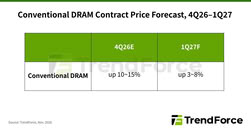
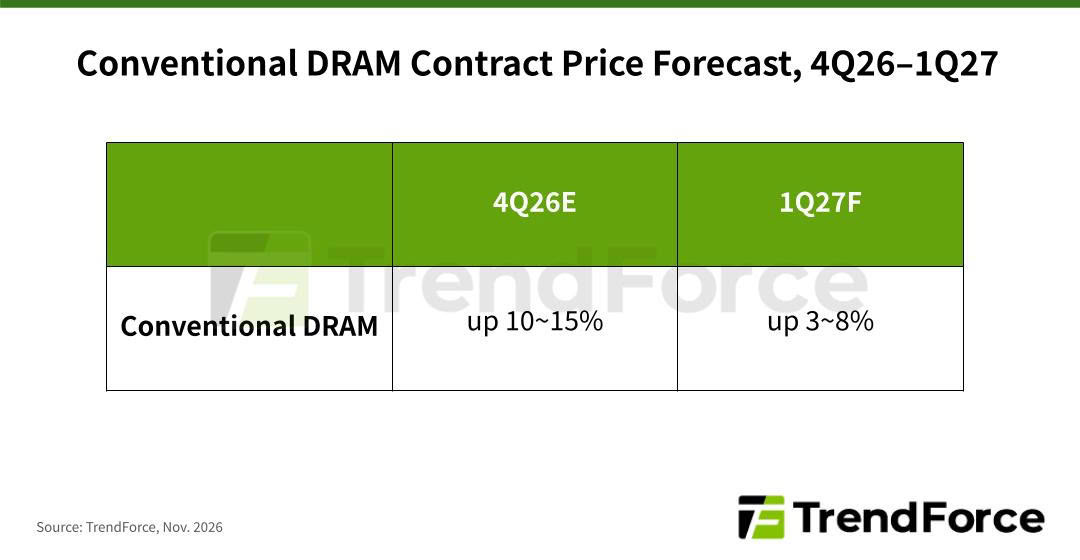
We have heard several predictions from industry leaders about how long the DRAM shortage is expected to last. SK hynix expects the shortage to last through 2030, Micron's CEO expects things to get worse in 2027 and 2028, and Dell's CEO also said something similar. However, it looks like that timeline might be a bit overblown. According to the latest TrendForce report, contract DRAM prices may start leveling off in the second half of 2027, and might even drop in 2028. Apparently, DRAM supply chain players have been reassessing their 2027/2028 production and sales plans since early Q4 2026, which has resulted in a slowdown in DRAM procurement.
The reason behind this slowdown is multifactorial. Chinese cloud providers apparently began reducing their server DRAM orders early this quarter, but that supply was mostly diverted to North American clients. Moreover, there's also the potential for a revised U.S. stance on data center construction since the midterm elections. NVIDIA is also in the mix, possibly scaling back financing for neocloud providers. Overall, TrendForce's read is that server shipment growth will start slowing down in 2027 (in the best case). Meanwhile, DRAM bit supply is expected to grow due to new capacity and process migration. This reads a lot like Acer CEO Jason Chen's opinion that memory makers might be overstating the shortage to protect their margins. However, this is a forecast based on industry trends, and we don't really know when prices will actually start falling for consumer DDR5 kits.
Source:
TrendForce
The reason behind this slowdown is multifactorial. Chinese cloud providers apparently began reducing their server DRAM orders early this quarter, but that supply was mostly diverted to North American clients. Moreover, there's also the potential for a revised U.S. stance on data center construction since the midterm elections. NVIDIA is also in the mix, possibly scaling back financing for neocloud providers. Overall, TrendForce's read is that server shipment growth will start slowing down in 2027 (in the best case). Meanwhile, DRAM bit supply is expected to grow due to new capacity and process migration. This reads a lot like Acer CEO Jason Chen's opinion that memory makers might be overstating the shortage to protect their margins. However, this is a forecast based on industry trends, and we don't really know when prices will actually start falling for consumer DDR5 kits.
19 Comments on DRAM Prices May Level Off in Late 2027 Before Dropping in 2028
2028 might be an accurate expectation, I said this before... the techbros cannot sell another year of 'yeah, need more pls' while not destroying the world as proof they reached something great. I also think we've already seen the miracles AI can bring, or, the larger part of them at least. We're gonna be happy and content chewing on the tech as is right now for quite a while - and its still on a trajectory of causing major disruption, especially to everything that is code.
This is inherently the problem. In the era of cheap consumer RAM they were selling at cost or a loss to keep the lights on and many companies have gone under. Now is a boom time. But they need to be ready for a bust which means no expansion.
What PC gamers want is simply not compatible with a market or reality. So they need to get ready and accept gaming as a service on the cloud. Or you know, stop gaming.
We've had cheap RAM every time the memory makers got sued for price fixing and collusion, which is simply what they're doing again, but on a scale much worse than the last time the memory mafia was caught price fixing when prices doubled and tripled in 2016.
The entire PC industry needs affordable memory again, not just gamers, or the entire market will keep retracting until only the ultra wealthy own a PC, memory prices will inevitably affect businesses and critical infrastructure as well causing prices of everything to increase.
Although the hyperscalers don't want mere users to have memory, let alone to play games on a locally owned PC. Gamers aren't going to stop gaming just because RAM Altman wants to hoard the majority of the entire worlds memory supply, we'll make do until the bubble pops.
today I went to the market and I saw purple peppers. they said they may get more but might not. they may get yellow or green, but it may juist be red ones.
thats how you make fluff posts to keep traffic moving. all speculations assumptions and guessing.
Nah, if we can't afford new PCs, then we'll game on old ones, and the gaming industry will adapt. If you don't believe it, then just look at how good a 1080 Ti still is.
Between billions of people and any corporation, I choose the people. I say this as someone who has invested heavily in several of these companies.
So should I spout irrational nonsense like you do just because of that? No, I'd rather have some human decency.
Plus, there’s no reason to take a loss. If supply increases, simply improve consumer products by putting more DRAM in each device. Supply and demand will balance out at an appropriate level.
It is exactly as I predicted. Cloud works for a segment of games/players/market. It will never work to carry gaming on its own.
PC gaming cloud revenue has stalled and remained steady for several years now, and on console, the revenue share is actually going down. And every time a service reduces its library or somehow strangles players with a higher price, a removed game, or whatever else, players get more and more reality checks as to what cloud gaming really means: you control nothing, you're subbed forever to keep gaming, and the quality of the experience will always be trailing a game that runs locally.
It doesn't take a rocket scientist to figure out this is a dead end. Every single cloud based on demand service, gaming and video, has been increasing prices YoY that rise faster than inflation - and inflation has been rather high by itself. If a cloud service wants to make a real profit on top of running all those expensive servers for every user all the time, they need to price themselves way beyond what physical media costs. It makes total sense, too, after all, a physical media does not require continuous distribution. That bill has to get paid on a cloud environment though - and on top of that, it requires all the licensing, the infrastructure, the security, and the connection latency needs to remain low while doing all of this. The only way this works is by massively increasing the price of gaming - it ain't gonna happen as long as we can just download said game and run it locally. Cloud is a straight up devolution compared to that - more expensive, lower in quality. The only people you can sell that to, are those that cannot reach the real deal one way or another.
axis-intelligence.com/cloud-gaming-statistics/
So, I'm sorry but not sorry, your dystopia ain't gonna be happening.Pray tell, how did PC gamers make this possible the last 30 odd years and in the current day. Surely this is black magic then, given the fact there is high inflation, so people's pockets should be rather empty at this point, and they are also still dealing with the aftermath of crypto and the onslaught of AI on hardware.
Somehow, strangely enough, PC gaming survives all of this, and just keeps growing. I can tell you right here and right now: the general PC gamer crowd doesn't give a flying f... what commerce tries to strongarm us into. We buy what we want, and the marketplace is vibrant and full of options that are not at all, even remotely, or actively NOT cloud and proud of it. We're also one of the most elastic buyer groups on entertainment spending. If you fuck with us, you can quickly see the community mobilize against you, and you shall be nuked into the ground one way or another: review bombing, straight up boycott of sales, or we sail the high seas. And guess what: even despite all of that, the market grows. Companies put money into it, and get money out of it - more and more, every year. The platform grows faster than inflation does. You can't say that about a lot of markets or local economies unless they're the current hype.
PC gaming though? Year after year of growth, and a continuous stream of new innovations, ideas, technologies and progress. Elements that cloud gaming will also damage at their core, because ownership has moved away from us. That should tell you enough. Gaming will not survive on cloud alone - and therefore cloud is always just an addon, never core to it.